
Parenting is changing. Families today face unique challenges, and generic advice no longer works for everyone. This is where AI steps in, offering personalized tools to help parents create custom goals tailored to their child’s needs. Whether it’s improving sleep routines, supporting social skills, or managing developmental milestones, AI simplifies parenting by turning broad objectives into actionable steps.
Here’s how AI tools are making parenting more manageable:
- Personalized guidance: AI uses data like sleep patterns or behavior to suggest specific actions that fit your family’s lifestyle.
- Real-time adjustments: These tools adapt as your child grows or circumstances change.
- Goal tracking: Parents can set measurable goals, like improving bedtime routines, and monitor progress.
- Support for diverse families: Single parents, military families, or those with children who have special needs can find tailored advice.
Platforms like Brilliant Parenting lead the way by combining research-backed insights with features like onboarding quizzes, activity libraries, and 24/7 accessibility. These tools don’t replace parental intuition – they help parents feel more confident and focused, freeing up time for meaningful connections with their children.
Artificial intelligence tools that can make parents’ lives easier
Research Findings: How AI Improves Parenting Results
Early research suggests that AI-driven parenting tools can enhance both parental confidence and child development. However, more comprehensive studies are needed to solidify these findings.
AI’s Role in Better Goal Setting
AI tools are proving helpful in transforming vague parenting goals into practical, actionable steps. Instead of leaving parents with broad aspirations, these tools break them down into measurable tasks. This makes it easier for parents to stay consistent with routines and tailor their strategies to their child’s specific developmental needs. The result? A more efficient and focused approach to parenting.
Improving Parent Involvement and Child Growth
AI-supported parenting solutions have been linked to greater parental involvement. By automating routine tracking and offering timely suggestions, these tools free up parents to spend more meaningful time with their children. The personalized guidance provided by AI reduces uncertainty, helping parents feel more confident in their choices. This leads to better routines, stronger parent-child connections, and even benefits like improved emotional regulation and deeper bonds within the family.
Supporting Different Types of Families
AI tools also show promise in providing tailored support for a wide range of family structures. For single parents, these tools can offer guidance that helps alleviate feelings of isolation. Military families dealing with deployments may find stability through consistent AI-driven parenting support during challenging periods. Families with children who have special needs may benefit from AI’s ability to track behavioral patterns and fine-tune daily routines. Additionally, these tools hold the potential to adapt to and respect various cultural values and traditions, all while offering evidence-based advice. These insights highlight how AI could further personalize parenting support to meet diverse needs.
How AI Tools Customize Parenting Support
AI tools are transforming parenting advice by tailoring it to fit your family’s unique circumstances. By analyzing factors like family dynamics and individual parenting preferences, these tools move beyond one-size-fits-all solutions to provide guidance that feels personal and relevant.
Personalized Coaching and Guidance
Imagine having a parenting coach who understands your routines and adapts to your needs over time. AI platforms do just that by analyzing your parenting style and habits to offer tailored coaching. For instance, Brilliant Parenting uses an onboarding quiz to identify one of seven evidence-based parenting styles that best matches your family. From there, it delivers advice that aligns with your style while offering helpful features like reminders and progress updates to keep you on track.
Goal Tracking and Real-Time Adjustments
Parenting comes with constant change, and AI tools are designed to keep up. They can track your goals and adjust their recommendations in real time as your family’s needs evolve. Whether it’s managing your child’s developmental milestones or adapting to shifting family dynamics, these tools provide updated guidance to help you stay focused on both immediate challenges and long-term objectives. The result? A more seamless way to navigate transitions and maintain balance within your household.
sbb-itb-e558fb0
Brilliant Parenting: A Case Study in AI-Assisted Parenting
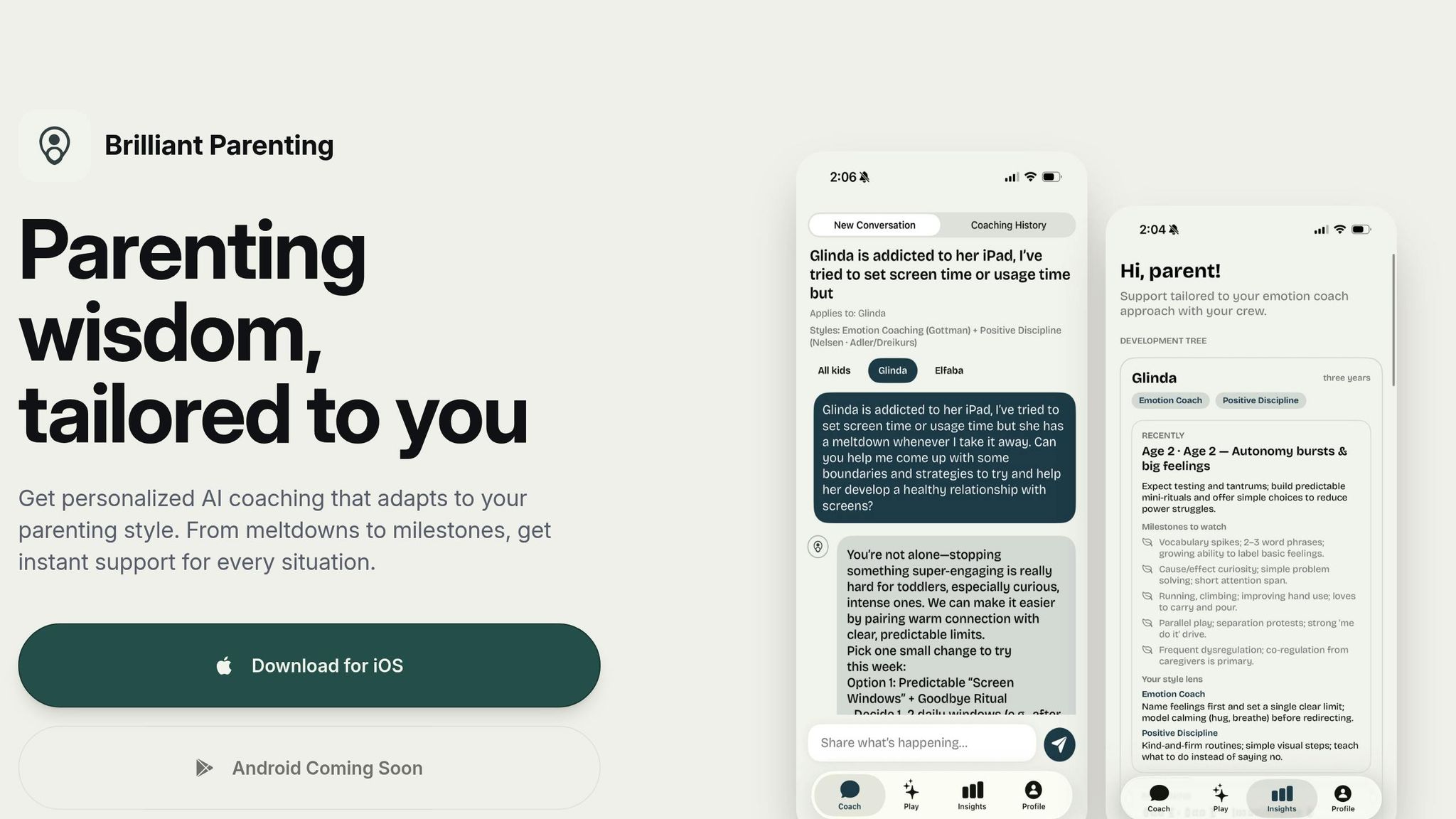
Brilliant Parenting is a prime example of how artificial intelligence can turn parenting research into actionable, personalized guidance. This platform bridges the gap between theoretical parenting concepts and real-world solutions, offering tailored advice that evolves alongside a family’s unique needs.
By combining evidence-based strategies with AI-driven adaptability, the platform provides a dynamic support system for parents. It’s a practical demonstration of how technology can reshape parenting assistance.
Key Features of Brilliant Parenting
Brilliant Parenting stands out for its thoughtful integration of AI into everyday parenting. Here’s what makes it special:
- Onboarding quiz: This initial assessment matches parents with one of seven evidence-based parenting styles. It forms the foundation for personalized recommendations that align with their natural approach.
- Play ideas library: Parents can access a curated collection of age-appropriate activities tailored to their child’s developmental stage and interests. This eliminates the guesswork of finding meaningful ways to engage children.
- Development tracking: The platform monitors progress in areas like social skills and cognitive development. Using this data, the AI suggests targeted activities or interventions to support a child’s growth.
- Support for multiple children: Families with more than one child receive individualized guidance for each child’s unique developmental stage.
- 24/7 accessibility: Parents can seek advice anytime, sidestepping the delays often associated with traditional parenting resources.
Every feature is rooted in research, ensuring that the advice provided is practical, reliable, and grounded in proven methods.
How Brilliant Parenting Uses Research
The platform’s strength lies in its commitment to research-backed solutions. Brilliant Parenting avoids fleeting trends, focusing instead on well-established principles from fields like child development, psychology, and family dynamics.
The seven parenting styles offered are the result of decades of research into effective parenting. By aligning parents with their natural style and offering strategies that fit within that framework, the platform ensures its advice feels authentic and manageable.
Additionally, the platform updates its recommendations based on the latest studies and aligns its development tracking tools with established developmental milestones. This approach not only helps reduce anxiety for parents but also promotes realistic expectations and timely interventions.
Practical tools like scripts and strategies are built on proven communication techniques and behavioral methods, giving parents access to the most effective guidance available. It’s a blend of science and practicality that empowers parents to navigate their journey with confidence.
Practical Tips for Using AI Tools in Parenting
Integrating AI tools into your family life can be a game-changer, but the key is to use them thoughtfully. These tools should support your parenting, not replace the personal connection that makes it meaningful.
Choosing the Right AI Tool for Your Family
Finding the right AI tool starts with understanding your parenting style and your family’s specific needs. What works for one family might not work for another, so it’s important to choose a tool that aligns with your approach.
For instance, some parents prefer a structured approach with clear rules, while others lean toward a more flexible, relationship-based style. Look for AI tools that adapt to your preferences instead of offering cookie-cutter advice. An example is Brilliant Parenting, which tailors its guidance through a personalized onboarding process.
If you’re parenting multiple children at different stages of development, you’ll want a platform that offers individualized advice for each child. On the other hand, if you have one child, you may focus more on in-depth content rather than multi-child features.
Another factor to consider is availability. Parenting doesn’t stick to a 9-to-5 schedule, so tools that are accessible 24/7 can be a lifesaver. Whether it’s managing a toddler’s tantrum in the evening or addressing a teen’s sudden issue late at night, having support whenever you need it is crucial.
Finally, choose tools that rely on research-backed content. The best platforms base their advice on established studies in child development and psychology, steering clear of trendy, unproven methods. Make sure the tool explains the science behind its recommendations, so you can trust the guidance it provides.
Once you’ve chosen a tool, it’s time to set realistic goals and integrate it into your routine without letting it overshadow quality family time.
Setting Realistic and Measurable Goals
AI tools are excellent for breaking big parenting goals into smaller, manageable steps, but it’s important to approach this process strategically. Start small and build momentum gradually.
Focus on one specific area at a time. For example, you might want to improve bedtime routines, encourage more focused play, or help your child with emotional regulation. AI tools can help you turn these broad goals into actionable steps.
Set goals that are specific and measurable, like “spend 20 minutes on focused play three times a week.” This makes progress easier to track, and many platforms even offer tracking features to monitor improvements in areas like social skills or cognitive development.
Keep your child’s age and developmental stage in mind. A 3-year-old’s needs and abilities are vastly different from those of an 8-year-old. Tools that align their advice with developmental milestones can help you set goals that are both realistic and age-appropriate.
Be prepared for setbacks. Life happens – kids get sick, routines get disrupted, and plans fall apart. The best AI tools help you adapt and adjust without feeling like you’re starting over every time something unexpected occurs.
With clear, achievable goals in place, you can use AI tools to enhance your parenting while keeping your relationship with your child front and center.
Balancing AI Use with Parent-Child Time
AI tools are there to support you, not replace you. They’re most effective when they free up your mental energy and give you confidence, allowing you to be more present with your child.
Use these tools for planning and reflection, not during real-time interactions. For example, you could review activity suggestions or read up on developmental insights during your morning coffee or after your child’s bedtime. This way, you’re prepared and fully engaged when you’re spending time with your child.
Adapt the advice to fit your family’s personality and needs. If the tool suggests conversation starters or activities, tweak them to feel natural rather than sticking rigidly to a script. The goal is to feel confident and prepared, not robotic.
To avoid interruptions, set aside specific times to review the AI’s suggestions. Make mental notes of challenges or moments you want to address later, and revisit them during your next planning session with the tool.
Most importantly, trust your instincts. AI tools are great for providing guidance based on data and research, but no one knows your child better than you do. Use the tools to inform your decisions, but rely on your intuition when something doesn’t feel quite right.
Parents who successfully use AI tools often say they feel more intentional and confident in their choices. These tools can help you navigate the complexities of parenting without second-guessing yourself, all while preserving the special connection that makes parenting so rewarding.
Conclusion: Using AI for Confident Parenting
AI tools are changing the way parents tackle the challenges of raising children. By tailoring advice to match each family’s unique needs, these platforms allow parents to move beyond one-size-fits-all suggestions and focus on personalized goals. Instead of replacing a parent’s instincts, AI works to enhance them, offering a clearer path forward. It breaks down large, daunting parenting objectives into smaller, actionable steps that are easy to monitor and adjust as kids grow and situations shift.
The goal isn’t to override parental intuition – it’s to refine it. With this added clarity and confidence, parents can approach their role with greater purpose, handle obstacles more effectively, and make decisions with assurance. AI’s strength lies in its ability to simplify and organize complex parenting tasks while remaining adaptable to the ever-changing dynamics of family life.
Platforms like Brilliant Parenting stand out because they combine research-based insights with round-the-clock availability. This means parents can rely on trustworthy, science-backed advice whenever they need it – whether they’re navigating a tough moment or planning activities that support their child’s development.
The key to success with AI tools is understanding that they are there to support, not replace, the human element of parenting. These tools help parents prepare for meaningful interactions and reflect on their experiences, enabling them to be fully engaged during important family moments. By enhancing confidence and streamlining decision-making, AI allows parents to spend more quality time with their children, strengthening their bonds rather than weakening them.
In today’s fast-paced world, where families juggle demanding schedules and diverse needs, AI-powered parenting tools offer a practical and personalized approach. Research consistently shows that when parents have access to tailored, evidence-based advice, both their confidence and their children’s outcomes improve. For modern families, these tools are becoming an essential resource for intentional, confident parenting in our digital age.
FAQs
How does AI tailor parenting advice as my child grows and family needs evolve?
AI offers personalized parenting guidance by aligning its advice with your child’s age, developmental progress, and individual interests. It also takes into account shifts in your family dynamics, ensuring the recommendations remain practical and relevant as your circumstances evolve.
By identifying patterns and using proven strategies, AI supports parents in confidently managing each phase of their child’s development, tackling unique challenges and milestones along the way.
How can AI tools support parents in achieving their parenting goals?
AI tools offer customized support designed to match your child’s specific needs, taking into account factors like their age, developmental stage, and overall well-being. Instead of relying on one-size-fits-all advice, these tools adjust to your family’s unique situation, providing practical tips and strategies that fit your everyday life.
They also make it easier for parents to connect with their children by suggesting activities that encourage both skill development and emotional bonding. By blending research-backed insights with real-time assistance, AI empowers parents to tackle challenges and celebrate milestones with confidence, all while feeling that the guidance is tailored just for them.
How can AI tools like Brilliant Parenting help single parents or families with children who have special needs?
AI tools such as Brilliant Parenting are designed to offer personalized guidance for single parents and families raising children with special needs. These tools combine evidence-based coaching, practical tips, and on-demand resources to help parents tackle challenges with greater confidence and ease.
From organizing daily routines to understanding developmental milestones or addressing unique parenting hurdles, AI-powered insights aim to simplify the journey and make parenting feel more manageable and fulfilling.