
AI parenting style matching is a new way to help parents navigate the challenges of raising children. Using machine learning, these tools analyze family dynamics, parenting habits, and child behavior to offer personalized advice. Unlike generic parenting guides, AI provides suggestions tailored to your family’s unique needs, values, and routines.
Key Points:
- How it works: Parents answer questions about their goals, challenges, and routines. AI uses this data to recommend strategies based on research-backed parenting styles.
- Why it’s popular: It offers customized, 24/7 guidance for busy families, addressing the limitations of one-size-fits-all advice.
- Parenting styles: AI identifies approaches like authoritative, permissive, authoritarian, and uninvolved parenting, ensuring advice fits your situation.
- Benefits: Provides tailored, evidence-based insights, tracks progress, and helps maintain consistent parenting.
- Challenges: Privacy concerns, over-reliance on tech, and potential gaps in understanding specific family contexts.
By blending technology with child development research, AI tools like Brilliant Parenting aim to simplify parenting while respecting the emotional and intuitive aspects of raising kids.
Research on AI-Assisted Parenting Style Matching
Researchers are diving into how AI can connect established parenting theories with the everyday challenges families face. By merging knowledge from child development with machine learning, AI systems are being developed to provide practical, tailored advice for parents. This research serves as the groundwork for understanding how AI can make a meaningful difference in parenting.
How AI Evaluates Parenting Styles
AI systems analyze parenting styles by examining how parents communicate and behave. They compare this data to well-known frameworks like authoritative, permissive, and authoritarian parenting styles, recognizing that most families naturally blend elements from multiple approaches. Using techniques like sentiment analysis, these systems pick up on the emotional tone in parental interactions. This allows the AI to offer suggestions that align with both a parent’s intended methods and their real-life habits.
Findings from Recent Studies
Early research is showing encouraging results. Studies indicate that when AI advice aligns closely with a family’s natural preferences and values, parents are more likely to follow and stick with the recommendations. Tailored and culturally aware AI suggestions have been shown to improve family relationships and dynamics in these initial findings.
Key Methods in AI Parenting Research
To study AI-assisted parenting, researchers use a variety of methods. These include grouping families with similar profiles, conducting long-term studies, and applying advanced natural language processing techniques. These approaches help uncover connections between parenting behaviors and child development, forming the basis for the personalized advice AI systems provide to families in the United States.
Evidence-Based Parenting Styles Used in AI Matching
AI systems draw on decades of child development research to identify parenting styles that serve as the foundation for personalized family support.
Overview of Parenting Styles
Parenting styles are broadly categorized into four main types, a classification originally developed by developmental psychologist Diana Baumrind and later expanded by researchers Maccoby and Martin. These categories are based on two key dimensions: demandingness and responsiveness.
- Demandingness: This refers to the extent to which parents enforce rules, set expectations, and regulate their children’s behavior.
- Responsiveness: This reflects the level of warmth, support, and acceptance parents show in their interactions with their children.
Here’s a breakdown of the four parenting styles:
- Authoritative Parenting: Combines high demandingness with high responsiveness. These parents set clear rules and expectations, but they also explain the reasoning behind them. They encourage independence while maintaining a supportive and nurturing environment.
- Authoritarian Parenting: Characterized by high demandingness but low responsiveness. Parents in this category enforce strict rules and expect unquestioning obedience, often with little explanation or warmth.
- Permissive Parenting: These parents are warm and accepting but provide minimal structure or consistent boundaries. While they show affection, they avoid enforcing rules or expectations.
- Uninvolved Parenting: Marked by both low demands and low responsiveness, this style involves minimal guidance, attention, or emotional support from parents.
AI Criteria for Style Identification
When analyzing family dynamics, AI systems use these well-established parenting styles as a framework. Grounded in decades of research, these classifications help AI provide tailored recommendations and strategies to support diverse family needs. By identifying which parenting approach aligns best with a family’s unique situation, AI aims to offer practical and personalized guidance.
Benefits and Challenges of AI Parenting Style Matching
AI-powered parenting tools bring clear advantages by offering tailored, data-driven recommendations, but they also come with some important considerations for families to keep in mind.
Benefits of AI-Assisted Parenting
Tailored Advice – AI can provide parenting guidance that’s specifically designed around a family’s unique dynamics, a child’s personality, and the household’s needs. It even takes into account family values, schedules, and other personal factors.
Always Available – These tools are accessible 24/7, making them a reliable resource for addressing parenting challenges whenever they arise.
Data-Backed Insights – By tracking patterns and progress, AI identifies what strategies work best for a child. This removes much of the guesswork from parenting and offers clear, evidence-based suggestions.
Consistency in Parenting – AI helps parents maintain a steady approach to their chosen parenting style, even in different situations. This is especially helpful for families with multiple kids or parents who need to stay on the same page.
While these benefits can be game-changers, there are some challenges to navigate.
Challenges and Risks
Privacy Concerns – AI systems collect sensitive data about family life and child behavior. Parents need to carefully assess how this information is stored, who can access it, and how secure it is.
Too Much Dependence on Tech – While AI offers helpful support, it can’t replace a parent’s intuition, emotional bond, or deep understanding of their child. Relying too heavily on technology might undermine confidence in natural parenting instincts.
Cultural and Individual Gaps – AI might not fully understand or accommodate specific cultural practices, religious beliefs, or unique family circumstances. Families with diverse needs may find the advice less relevant or helpful.
Risk of Misunderstanding – Limited data can lead AI to misinterpret situations, resulting in advice that misses key context – something a human counselor would likely catch through deeper, personal interaction.
Comparison Table: Pros and Cons
| Benefits | Challenges |
|---|---|
| Tailored advice based on family needs | Privacy risks with sensitive data |
| Round-the-clock availability | Over-reliance on technology |
| Tracks progress with evidence-based insights | Struggles with cultural or individual nuances |
| Promotes consistent parenting approaches | May misinterpret complex situations |
| Affordable alternative to traditional consultations | Lacks human intuition and emotional depth |
Striking the right balance is crucial. Parents who see AI as a helpful tool rather than a complete replacement for their judgment tend to get the most out of it. This approach allows families to enjoy the convenience and analytical strengths of AI while preserving the emotional and intuitive aspects that make parenting deeply personal and meaningful.
sbb-itb-e558fb0
How Brilliant Parenting Supports US Families
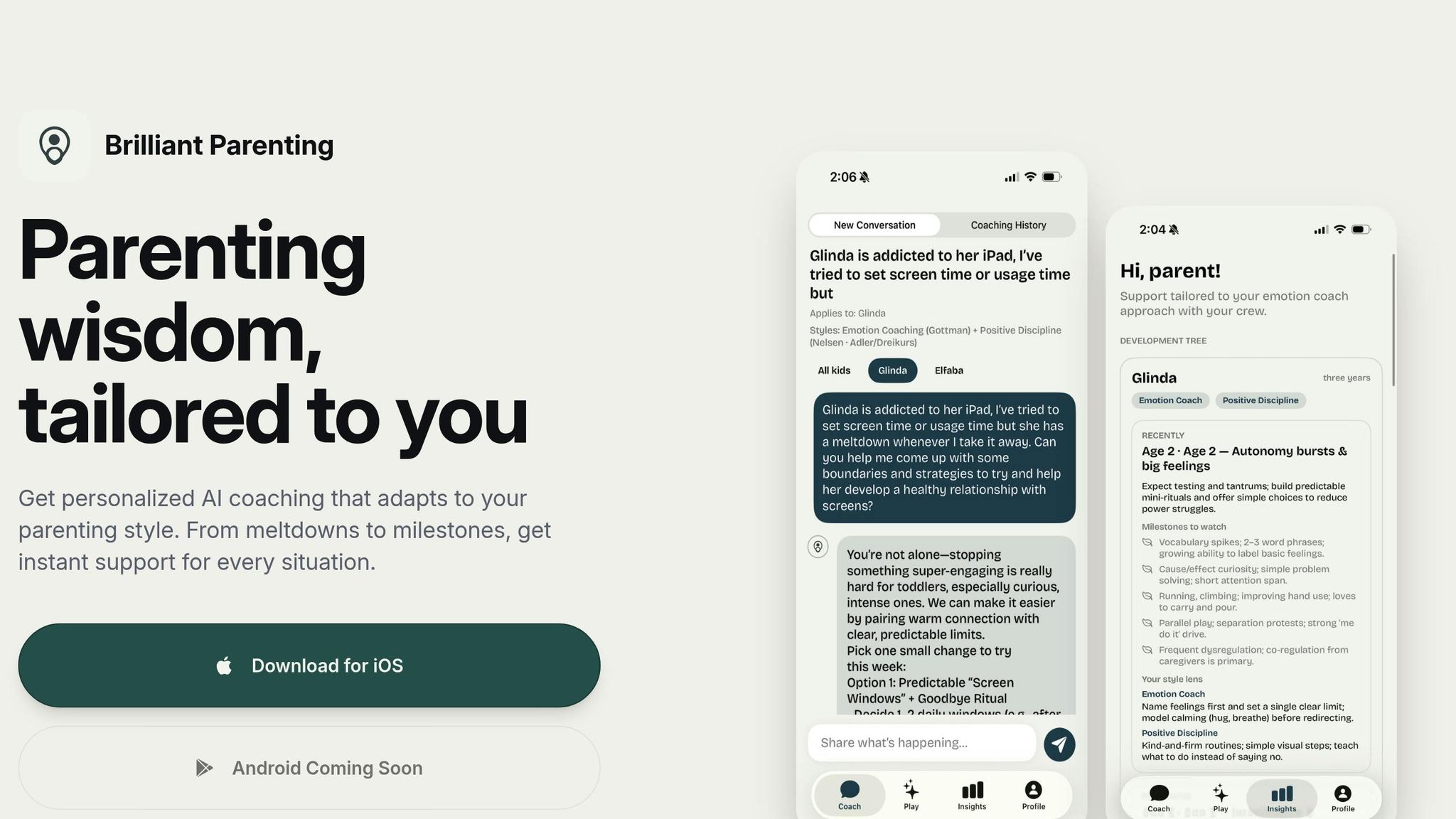
Brilliant Parenting brings evidence-based AI to the forefront of family support, offering personalized parenting strategies that fit the busy and diverse lives of US families. By turning research into practical tools, this platform helps parents navigate their daily challenges with ease and confidence.
Personalized Parenting Support
Brilliant Parenting uses a smart matching system to provide tailored strategies for families. It all starts with a simple onboarding quiz that identifies your family’s parenting style from seven evidence-based options. For example, if your family aligns with an authoritative style, you’ll receive tips on balancing clear rules with warmth, ensuring a harmonious approach to parenting.
But it doesn’t stop there. The platform adapts as your family grows, fine-tuning its advice to stay relevant through every stage of your child’s development.
Key Features for US Families
Understanding the unique needs of American families, Brilliant Parenting offers features designed to make parenting more manageable:
- Development Tracking: Keep an eye on important milestones.
- Multi-Child Support: Get tailored advice for each child in your family.
- 24/7 Availability: Access expert guidance whenever you need it.
- Play Ideas Library: Explore a collection of age-appropriate activities to keep your kids engaged.
Building Confidence Through AI Coaching
Brilliant Parenting doesn’t just offer solutions – it helps parents feel more confident in their roles. Through proactive AI coaching, the platform provides consistent, research-backed guidance to help manage day-to-day challenges and prepare for what’s ahead. This forward-thinking approach equips parents to anticipate developmental phases and build a strong foundation for their family’s future.
Conclusion: The Role of AI in Modern Parenting
AI is reshaping the way families approach parenting, offering tools that analyze behaviors, recommend evidence-based strategies, and provide personalized guidance tailored to each family’s unique dynamics. By interpreting data from questionnaires and observed behaviors, AI creates clear, actionable insights that help parents understand why certain approaches work best for their specific situation.
For families in the United States, AI delivers on-demand advice designed to fit the fast-paced, ever-changing nature of modern life. From tracking developmental milestones to juggling the needs of multiple children, these tools provide access to research-backed strategies any time of day, making them an invaluable resource for busy parents.
Platforms like Brilliant Parenting highlight how this technology can seamlessly integrate into daily life. By identifying parenting styles and adapting as families grow, these tools enhance parental confidence and strengthen family connections. Importantly, they complement human intuition rather than replace it, showing how technology can support, not overshadow, the human aspects of parenting.
As AI continues to evolve, its ability to refine matching algorithms and offer even more tailored support will grow. These advancements promise to provide families with increasingly personalized guidance, ensuring that every parenting journey is met with well-researched and practical advice.
FAQs
How does AI provide parenting advice that respects different cultural backgrounds and family values?
AI systems are built to process a wide range of data and adjust their recommendations to respect different cultural norms and family values. By drawing on evidence-based research and incorporating feedback from parents, these systems aim to provide advice that resonates with individual preferences and circumstances.
On top of that, personalized AI coaching tools can fine-tune suggestions to match specific parenting approaches, making the guidance more practical and relatable for families with diverse backgrounds and lifestyles.
How is family data kept private and secure when using AI parenting tools?
When it comes to AI parenting tools, protecting your family’s privacy and securing your data is a key concern. These tools often rely on advanced encryption to keep your information safe, both while it’s being stored and when it’s being transmitted. On top of that, personal data is usually anonymized whenever possible, reducing the risk of unauthorized access or misuse.
Trusted platforms also adhere to strict regulations like the California Consumer Privacy Act (CCPA) and the Children’s Online Privacy Protection Act (COPPA). These laws are in place to make sure your data is handled with care and responsibility. To stay informed, take the time to review the privacy policy of any platform you use – this will give you a clear picture of how your information is managed.
Can AI parenting tools adjust to changes in family dynamics and a child’s development over time?
AI parenting tools are built to evolve alongside your family, adjusting to changes in dynamics and your child’s growth. By analyzing patterns and feedback, they offer guidance tailored to your family’s specific needs and milestones.
These tools use advanced algorithms to factor in shifts like developmental stages, behavioral changes, or new family situations. This ensures the advice stays relevant and practical, giving parents the support they need as they navigate the constantly shifting landscape of raising kids.