AI tools are reshaping parenting by offering personalized advice, tracking milestones, and improving parent-child communication. These tools are accessible 24/7, making them convenient for managing challenges like tantrums or developmental concerns. Research highlights benefits like reduced stress for parents and improved interactions with children, but there are concerns about over-reliance, privacy, and cultural sensitivity. The key takeaway? Use AI as a supportive tool, not a replacement for your instincts and judgment. Here’s what you need to know:
- Benefits: Instant access, tailored advice, and pattern recognition for better parenting decisions.
- Challenges: Privacy risks, potential over-dependence, and limited contextual understanding.
- Best Practices: Combine AI insights with your judgment, stay informed about data security, and maintain open communication with your kids about technology’s role in your family.
AI tools like Brilliant Parenting provide research-based recommendations and features like milestone tracking and activity suggestions, but they work best when paired with your instincts and values.
The Impact of AI on Children’s Development | Harvard EdCast Ep. 446

Research Results: How AI Tools Affect Parenting
Recent studies are shedding light on how AI tools are influencing family dynamics and child development. While the findings vary, many highlight how these tools can support parent–child communication, enhance developmental progress, and improve parental well-being.
AI and Parent-Child Communication
Research suggests that AI tools are helping parents better understand how they interact with their children. For example, some apps use emotional recognition to pick up on subtle cues in a child’s behavior – like signs of stress, excitement, or confusion – that might otherwise go unnoticed. By identifying these cues, parents can respond more thoughtfully, leading to deeper and more meaningful conversations with their kids. Experts stress, however, that these tools are meant to complement parental instincts, not replace them.
This improvement in communication creates a stronger foundation for supporting a child’s growth and development.
AI’s Effect on Child Development
AI-powered tools are also playing a role in helping children meet developmental milestones. These tools often offer personalized activity suggestions tailored to a child’s age and interests, which can encourage growth in areas like cognitive, social, and emotional skills. For instance, some research shows that AI-recommended reading and interactive activities can positively impact language development. Still, researchers agree that more studies are needed to fully understand how to seamlessly integrate AI into everyday parenting routines.
Parental Confidence and Involvement
Better communication and developmental support don’t just benefit children – they also help parents feel more confident and engaged. Studies reveal that AI tools can reduce parental stress, improve decision-making, and encourage active participation in their child’s development. When parents view AI as a tool to enhance – not replace – their judgment, they often experience greater satisfaction and better outcomes for their families.
The early evidence suggests that AI can be a valuable ally for parents, especially when paired with their natural instincts and intuition.
Pros and Cons of AI-Assisted Parenting
Exploring how AI tools can influence family dynamics reveals both practical advantages and ethical challenges. While studies suggest that these tools can be helpful, it’s important for parents to weigh the benefits against the potential drawbacks. Let’s dive into the practical and ethical aspects of using AI for parenting support.
Benefits of AI Parenting Tools
One of the standout advantages of AI parenting tools is their round-the-clock availability. Unlike traditional resources that operate within fixed hours, AI tools are accessible whenever you need them. Whether you’re dealing with a toddler’s 2:00 AM tantrum or second-guessing a discipline strategy on a Sunday afternoon, help is just a click away.
Another significant perk is personalized guidance. These tools can tailor their advice based on factors like your child’s age, personality, and developmental stage. Instead of generic, one-size-fits-all recommendations, AI offers solutions that align with your family’s unique needs – whether you’re parenting a quiet preschooler or a high-energy teenager.
AI also shines in terms of accessibility. It can provide parenting support to families who might not have access to traditional resources. For example, rural families, single parents with limited time, or those unable to afford parenting classes can still benefit from evidence-based advice. This broader reach has the potential to bring valuable insights to millions of households.
Another powerful feature is pattern recognition. AI tools can analyze trends in your child’s behavior, sleep habits, or emotional responses – patterns that might be hard to spot in the daily hustle. These insights can help parents make better decisions and even catch potential issues early on.
While these advantages are compelling, there are also some serious concerns to consider.
Drawbacks and Ethical Issues
One of the biggest concerns is over-reliance on AI. Depending too heavily on algorithmic advice can undermine a parent’s instincts, potentially weakening the bond between parent and child. It might also erode confidence in making independent decisions.
Privacy concerns are another pressing issue. Many of these tools collect sensitive data about children’s behavior, family interactions, and personal struggles. Questions about how this data is stored, who can access it, and whether it could be misused by third parties or government agencies remain unresolved.
AI tools also face context limitations. While they can process vast amounts of information, they may overlook important factors like cultural values or unique family circumstances. A suggestion that works well for one family might be completely inappropriate for another.
Finally, there are accuracy and accountability challenges. If an AI tool provides incorrect advice, the consequences can be serious for children and families. Unlike human professionals who are bound by accountability and insurance, it’s unclear who bears responsibility when AI gets it wrong.
Comparison Table: Benefits vs. Drawbacks
| Benefits | Drawbacks |
|---|---|
| 24/7 availability | Risk of over-dependence |
| Tailored advice for your family | Privacy and data security concerns |
| Accessible to underserved families | Lack of cultural or contextual understanding |
| Identifies behavioral patterns | Potential for inaccurate or harmful advice |
| Affordable compared to traditional counseling | Unclear accountability for mistakes |
| Scaled, evidence-based insights | Could weaken parental instincts and confidence |
The best approach is to use AI parenting tools as a complement to, not a replacement for, human judgment, family values, and the irreplaceable connection between parent and child. Balancing these tools with your own instincts and knowledge can help ensure they serve as a helpful aid rather than a crutch.
sbb-itb-e558fb0
Best Practices for Using AI in Parenting
To get the most out of AI tools in parenting, it’s essential to balance technology with your own instincts and values. Research shows that AI can enhance parent-child interactions, but it works best when used thoughtfully. The secret lies in understanding how these tools operate, blending them into your parenting style, and being open with your children about their role in your household.
Learning About AI as a Parent
Understanding how AI functions is the first step in using it effectively. These tools rely on algorithms to identify patterns in data and offer recommendations. However, remember that their advice is only as good as the information they’ve been trained on, and they can’t account for every unique situation your family might face.
Before using any AI tool, dig into the evidence behind it. Look for platforms that base their recommendations on solid research, established child development principles, and input from qualified professionals. Be cautious of tools that can’t explain their methods or seem to give advice without a clear scientific foundation.
It’s also important to recognize the limits of AI. These systems often struggle with complex emotional issues, nuanced cultural contexts, and situations where quick human judgment is needed. While they’re great for general guidance – like tips on sleep routines or developmental milestones – they’re not a substitute for addressing serious behavioral or mental health challenges.
By understanding what AI can and cannot do, you’ll be better prepared to integrate it into your everyday parenting.
Combining AI with Regular Parenting
Think of AI as a helpful assistant, not a decision-maker. It can provide you with quick, research-based insights, but the final call should always be yours.
For example, if you’re curious about your toddler’s language development, an AI tool might offer milestones and activities to try. However, this information should complement – not replace – advice from your pediatrician, observations from caregivers, and your own day-to-day experiences with your child.
When implementing AI suggestions, adapt them to align with your family’s values. If a recommended discipline strategy clashes with your approach to resolving conflicts, tweak it to fit your principles rather than abandoning what works for your family. AI can offer a starting point, but it’s your personal touch that makes the advice meaningful and effective.
It’s also important to check in with yourself. If you notice that AI is making you second-guess your instincts or feel anxious when it’s unavailable, it might be time to step back. The goal is for AI to boost your confidence and knowledge – not make you overly reliant or uncertain.
Keeping Open Communication
As you bring AI into your parenting routine, keeping an open line of communication with your children is crucial. Being transparent about AI’s role in your family helps them develop a healthy understanding of technology and reinforces trust in your relationship. Tailor your approach to their age and maturity level.
For younger kids (ages 3-7), keep it simple. You might explain, “Sometimes I use an app to find fun activities for us to do” or “This helps me learn what kids your age enjoy.” Avoid portraying AI as all-knowing or magical, as this could lead to unrealistic expectations.
With school-age children (ages 8-12), you can go into more detail. Explain that AI tools help you quickly find information, much like how they might use apps for schoolwork. Stress that while AI offers suggestions, you make the final decisions based on what’s best for your family.
Teenagers are likely already familiar with AI through social media or educational tools, so have open, honest conversations about its benefits and limitations. Sharing how you evaluate AI advice can also encourage them to think critically about the technology they encounter in their own lives.
Pay attention to how your children react to these discussions. Some might be curious and want to learn more, while others might feel uneasy about technology’s role in family decisions. Adjust how much you share or how you use these tools based on their comfort levels.
Finally, model balanced technology use. Show your kids that while AI is a helpful resource, it’s just one of many tools you rely on. Let them see you consulting with other parents, reading books, talking to teachers and doctors, and most importantly, listening to their unique needs and preferences when making decisions. This approach reinforces the idea that parenting is a thoughtful, human-centered process.
How Brilliant Parenting Provides AI-Assisted Support
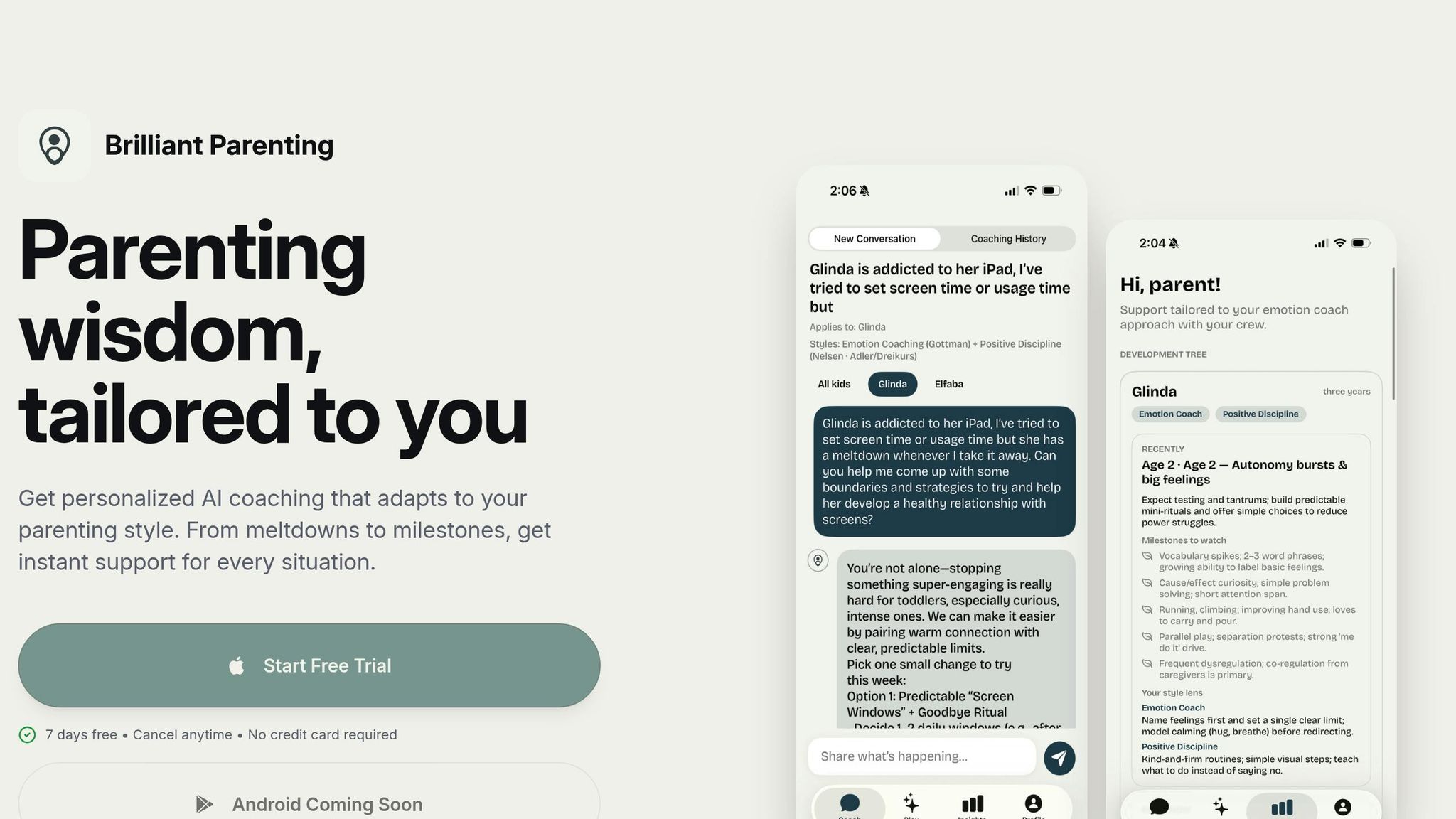
Brilliant Parenting showcases how technology can seamlessly integrate into family life, offering practical tools and strategies to support parents in their everyday challenges. By combining AI with evidence-based methods, it brings research-backed solutions to life in a way that feels approachable and actionable.
Personalized Coaching That Fits Your Parenting Style
Through an onboarding quiz, Brilliant Parenting identifies your parenting style from seven evidence-based approaches. Based on your results, the platform provides tailored strategies and practical scripts to address everyday parenting situations. This personalized guidance ensures the advice you receive aligns with your unique approach to parenting.
Key Features Designed for Parents
Brilliant Parenting is packed with tools to strengthen parent–child relationships and build confidence in your parenting decisions. Here’s what you can expect:
- 24/7 Support: Get immediate help whenever you need it.
- Curated Play Ideas: Access activities designed to promote developmental skills.
- Development Tracking: Easily monitor your child’s milestones and progress.
- Multi-Child Profiles: Receive individualized guidance for each child in your family.
- Research-Based Recommendations: All advice is grounded in child development studies.
Always Accessible with a Free Trial Option
The platform’s user-friendly interface ensures you can find solutions anytime, day or night. Plus, you can explore all its features with a 7-day free trial before deciding if it’s the right fit for your family.
Conclusion: What’s Next for AI in Parenting
As we’ve explored, AI tools are becoming a helpful companion for parents, complementing traditional methods rather than replacing them. Research shows that these tools can boost parental confidence, improve communication, and provide clarity on child development milestones.
The key lies in balance – AI works best when it supports human judgment and emotional connections, rather than trying to replace them. The most effective solutions blend evidence-based research with personalized recommendations, empowering parents to make informed choices while staying true to their family values.
Looking ahead, advancements in AI are likely to focus on deeper personalization and stronger integration with child development research. These improvements aim to provide parents with tailored support, all while respecting their instincts and parenting styles.
Platforms that emphasize transparency, research-backed guidance, and respect for individual parenting approaches can make a real difference. The goal isn’t perfection in parenting or child-rearing but offering accessible tools that help families thrive in their own unique way.
In a world where technology is increasingly woven into daily life, using AI thoughtfully and intentionally can help parents tackle modern challenges with confidence. The future of AI in parenting isn’t about replacing parents – it’s about helping them feel more confident and supported in their crucial role.
FAQs
How can I make sure AI tools protect my family’s privacy when using them for parenting support?
When using AI tools for parenting, safeguarding your family’s privacy is crucial. Start by carefully reviewing each tool’s privacy policy. This will help you understand how your data is collected, used, and shared. Choose tools that are clear about their practices and give you control over data collection.
Be cautious with AI devices or toys that ask for too much personal information. Make sure any tool you use follows child privacy laws like COPPA. To further protect your family, keep software updated and use strong, unique passwords. Staying informed about privacy measures will help you make safer, smarter decisions for your household.
How can I use AI tools in parenting without losing confidence in my own judgment?
To make the most of AI tools while staying true to your own judgment, it’s important to establish clear rules for when and how you’ll use them. Think of AI as a supportive assistant, not the one making the final call. Your instincts and personal values should always come first when making parenting decisions. Remember, AI suggestions can sometimes reflect biases or have limitations, so it’s wise to evaluate them critically. By blending technology with your own experiences and insights, you can take a balanced and confident approach to parenting.
How can AI tools adapt to different cultural backgrounds while respecting family values?
AI tools can be designed to resonate with diverse cultural backgrounds by emphasizing inclusivity and understanding. This starts with training AI systems using data that reflects a broad range of cultural norms and family dynamics, ensuring the advice they offer aligns with varying traditions and values.
Another key step is involving families from different cultural groups during the development process. Their input helps shape tools that address specific needs and preferences. Additionally, clear and open communication about how these AI systems function fosters trust, empowering parents to confidently rely on the guidance provided.